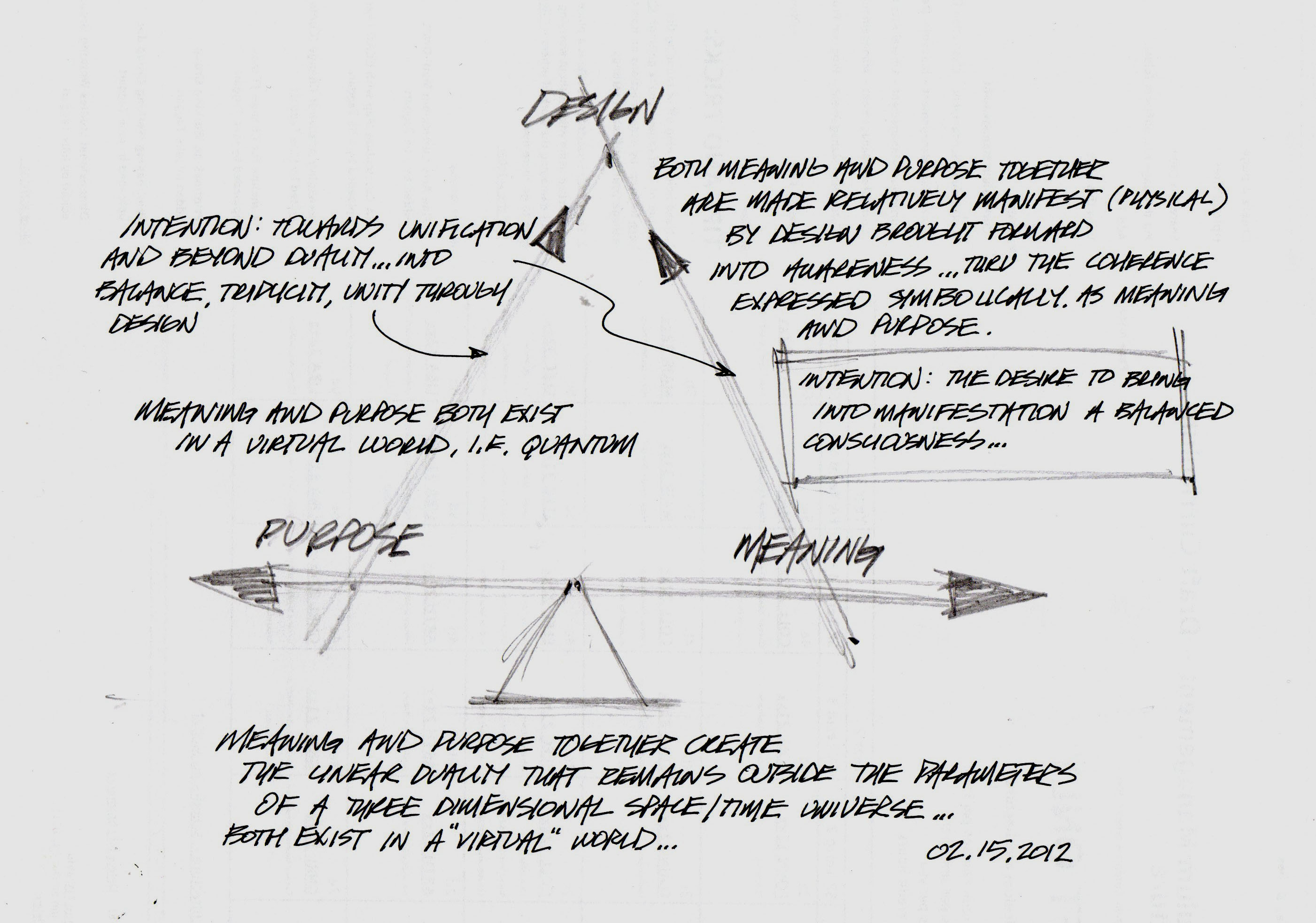
Conceptual impressions surrounding this post have yet to be substantiated, corroborated, confirmed or woven into a larger argument, context or network. Objective: To generate symbolic links between scientific discovery, design awareness and consciousness.
* * *
Your mind wants you to know what you believe. Your heart believes in what you know. Logically you feel you know what you think by believing what you think is true. What you know and believe are rooted in how you feel. Seek balance in what you think and believe by knowing how you feel.
"The neuroscientist Antonio Damasio distinguishes between emotions and feelings: Emotions are mental images (i.e. representing either internal or external states of reality) and the bodily changes accompanying them, whereas feelings are the perception of bodily changes. In other words, emotions contain a subjective element and a 3rd person observable element, whereas feelings are subjective and private. In general usage, the terms emotion and feelings are used as synonyms or interchangeable, but actually, they are not. The feeling is a conscious experience created after the physical sensation or emotional experience, whereas emotions are felt through emotional experience. They are manifested in the unconscious mind and can be associated with thoughts, desires, and actions."
* * *
“Emotions interpret the world for us. They have a signal function, telling us about our internal states as they are affected by input from the outside. Emotions are responses to present stimuli as filtered through the memory of past experience, and they anticipate the future based on our perception of the past.”
Thinking is driven by the mind and felt through the emotions. Along with the imagination they describe reality. Observations reflect between the past and the future and are of great influence. An attraction between “opposites” creates the framework (context, background, theater) for a new kind of experience, i.e. reality, to emerge.
Contrast is the causal agent of change and fundamental to the design process.
Can you observe what your feeling without becoming emotional?
An observer might be considered constant while in fact both the observer and the context are constantly changing.
Any sense of stability is felt and only to be discovered by means of coherent resonance.
Consciousness describes a state of mind that rests beyond the constraints of thought.
Thinking and feeling are attributes that bring light to awareness in every event and experience.
Design thinking makes Life incredibly simple using signs, symbols, metaphor and analogy.
Awareness brings forward a “sense of consciousness” by fostering correspondences and fusing the concepts of meaning and purpose. Metaphysical in content and context, quantum, fractal and holographic in representation, all forms of energy/Life are revealed and made apparent by means of Design. Design is lovingly veiled in all that can be seen, known, measured and/or felt. (07.09.2023)
Design describes a metaphysical and multidimensional process. The design process is dependent upon knowledge, understanding, intention, intuition, imagination and awareness. Design creates a network of energy in motion (EIM) between fields/states/points/agents and patterns of awareness. Design creates a virtual, symbiotic and metaphoric lattice between consciousness, the subconscious and the unconscious, the tangible and the intangible, the known and the unknown, the seen and the unseen. All forms of energy in motion are based upon principles of meaning and purpose both felt and understood. (01.13.2023)
* * *
Thinking, at its core, is an intricate process driven by the cognitive faculties of the mind, deeply interwoven with the emotional responses that color our experience of the world. This interplay between thought and emotion, in conjunction with the imagination, serves as a mechanism for describing and interpreting reality. It is through these cognitive and emotional faculties that individuals make sense of their existence and place in the universe. The act of observation is inherently dynamic, constantly oscillating between the past and the future, shaping our understanding of the present moment. These observations are not passive but are instead deeply influential in the formation of the experiential world we navigate. The interaction between opposing forces—whether they be conceptual, emotional, or physical—creates a framework or context in which new forms of experience, or reality, emerge. In this sense, reality is not a static entity but a constantly evolving manifestation, shaped by the tension between these seemingly divergent forces.
From a metaphysical perspective, one could argue that the observer is often regarded as a constant entity. However, this perception is illusory, as both the observer and the context in which they operate are in a perpetual state of flux. This aligns with the concept of fluxional metaphysics, which posits that reality is not only dynamic but also fundamentally relational and interconnected (Whitehead, 1929). The stability we feel, then, is not inherent to the observer but is a result of coherent resonance—a harmonious alignment between the internal world of the observer and the external world they perceive. The stability is not a given but a process that arises through relational processes of understanding and interaction.
Consciousness, when examined through both psychological and metaphysical lenses, can be understood as a state of awareness that transcends the immediate constraints of thought. It represents a form of being that exists beyond the mechanistic processes of the mind, reaching into the depths of existential experience. In this sense, consciousness can be seen as the substratum of all cognitive activities—a meta-awareness that underpins both thought and emotion, as well as perception and action. This idea aligns with phenomenological theories of consciousness, which suggest that awareness is not merely a byproduct of mental processes but rather a foundational structure that shapes our engagement with the world (Husserl, 1913).
The act of thinking and feeling, then, can be viewed as integral components of the ontological illumination that brings light to the events and experiences of life. These processes of cognition and emotion are not separate but are deeply intertwined, acting as complementary forces that foster awareness and understanding. It is through the engagement of both thought and feeling that individuals can come to a deeper understanding of themselves and the world around them. This duality of mind and emotion echoes the philosophical concept of duality, where two distinct yet interdependent forces come together to create a unified whole (Descartes, 1641).
In the domain of design thinking, these concepts of awareness and understanding find practical application. Design thinking, as an approach to problem-solving and innovation, distills the complexity of life into simple structures, often utilizing signs, symbols, metaphors, and analogies to represent complex ideas and relationships. The use of these symbolic forms acts as a bridge between the abstract and the tangible, allowing for the articulation of meaning and purpose in a manner that is both accessible and evocative. From a semiotic perspective, design can be understood as a process of constructing meaning through signs and symbols, a process that is deeply influenced by the structures of consciousness and the ways in which individuals interpret and make sense of the world (Eco, 1976).
Consciousness, in this context, takes on a multi-dimensional character—it is conceptual, illusory, symbolic, metaphoric, and virtual. In other words, consciousness is a meta-structure that exists as both a product and a generator of meaning. It is through the conscious and subconscious interaction that the mind creates and imbues the world with purpose and significance. As such, consciousness can be seen as the quintessential archetype, a foundational principle that governs not only the subjective experience of individuals but also the larger patterns of energy and motion that define the fabric of reality (Jung, 1959).
The concept of awareness, therefore, emerges as a key factor in fostering a "sense of consciousness." Awareness is the mechanism through which meaning is brought into existence, as it facilitates the alignment of disparate concepts—such as meaning and purpose—into a coherent, cohesive framework. The metaphysical nature of this process can be further explored through the lenses of quantum physics, which highlights the non-local and fractal aspects of reality. According to quantum theory, energy and matter are interconnected in ways that transcend classical conceptions of space and time, suggesting that the universe is a web of interdependent relationships rather than isolated entities (Heisenberg, 1958). In a similar fashion, the design process functions as a network of energy in motion (EIM), linking fields, states, points, agents, and patterns of awareness in a dynamic, ever-evolving dance.
Design, as a process, is fundamentally a metaphysical and multidimensional phenomenon. It draws upon a variety of cognitive and emotional resources—knowledge, understanding, intention, intuition, imagination, and awareness—each of which contributes to the creation of a virtual lattice that connects consciousness with the subconscious, the unconscious, the tangible, and the intangible. This lattice, which can be understood as a symbiotic network, creates a space in which meaning and purpose are made manifest, both felt and understood. The design process, therefore, acts as a conduit through which the unseen becomes seen, the unknown becomes known, and the intangible becomes tangible. In this way, design is both a reflective and generative process, revealing and shaping the very energy patterns that constitute the universe itself.
The author generated this text in part with GPT-3, OpenAI’s large-scale language-generation model. Upon generating draft language, the author reviewed, edited, and revised the language to their own liking and takes ultimate responsibility for the content of this publication.
Conceptual impressions surrounding this post have yet to be substantiated, corroborated, confirmed or woven into a larger argument, context or network. Objective: To generate symbolic links between scientific discovery, design awareness and consciousness.
Why do we Feel?
The nervous system is connected to many organs that together give reference to your physical body. Similarly, you have many emotional and mental (systemic and sub-systemic) “fields” you've created that surround you, including those beyond your current awareness and acting as buoys and beacons harboring the potential to penetrate the unknown. Together these fields create agencies, i.e. matrices and networks, for the transition and transformation all forms of EIM, i.e. Consciousness.
The language required for the interpretation, implementation and/or expression of this changing energy (CE) is Design. In reference to human awareness, every field is symbolic in Nature (meaning and purpose) describing the unique attributes of another field, within a greater field, within a greater field … ad infinitum.
Note: Fields of Consciousness are described for their Greatness and not for their size. Greatness like love, time, truth, goodness and beauty takes no space.
In reference to feelings, the mind and the emotions characterize the source of two vibratory fields we’ve described as integral to the creative (design) process. Along with a physical context, i.e. relative "matter", all three together create a field that functions in conjunction with an even “greater” field of high frequency. This higher frequency has its own effect and affect, is greatly felt and has been identified as being spiritual and aetheric in character. The vibrational effects and affects of the mind and the emotions are readily described, experienced and felt in tangent with that of the “Spirit”.
effect: a change which is the result or consequence of an action or other cause.
affect: having an effect on, make a difference to, touch the feelings of (someone), move emotionally.
Spirit lives in the heart and mind of the human, it can’t be measured, understood or fully felt, yet strives for balance within the Consciousness of every Observer.
Together the mind and the emotions create a subjective reality (network) known and felt only to the observer. By virtue of a subconscious filled with symbolic tone and flavor, can one journey into an unknown field of perpetual change (QFVPP). The agencies are self generated, symbolic, individual networks of attraction and communication (information) formlessly revealed in the vibratory realm (context) of a dream state. Here is where design affords consciousness the potential and opportunity to explore what is felt to be beyond the subjective reach of the mind and emotions.
Feeling describes who you are by virtue of its wholeness. This is what you are conscious of. Consciousness therefore, can be described precisely by how you feel.
"Consciousness is the fact of being aware."
Rupert Spira
That which embraces your physical, mental, emotional and spiritual Presence, i.e. states of awareness, are the same unifying agents that help you define and describe the feeling of consciousness – the feeling of Wholeness and being One within yourself.
Some might describe this quantum Presence as one’s Soul. The soul is what embraces these uniquely changing patterns of energy in motion (EIM) within a blueprint designed with meaning and purpose. The blueprint describes the qualities intrinsic to each part/piece that together reflect upon the conscious awareness of an observer, the parts of an ever-changing puzzle (context) made apparent in every waking and sleeping moment.
Such a blueprint describes the qualities that together mirror upon the wholeness of the observer, a design symbolically arranged within a range of flexibility and adaptability. Exercising the blueprint according to plan is part of what is called experience.
The blueprint of oneself describes the most important positions, avenues, portals and directives towards weathering the storms of change. The blueprint is the ballast that keeps your ship balanced within itself while riding the turbulent waves of greater Consciousness.
* * *
This passage offers a profound reflection on the relationship between consciousness, the mind, emotions, and the spiritual realm. It draws parallels between the nervous system and the fields of energy that shape our awareness, suggesting that just as our nervous system connects us to our physical body, our mind and emotions connect us to a broader, more subtle network of consciousness. Here, the "fields" refer to various dimensions of experience, from the physical and emotional to the spiritual, and these fields interact in a dynamic, interconnected in a manner that shapes the subjective reality of each individual.
The idea that each person creates their own unique fields, symbolic and energetic, suggests that our consciousness is not a passive receiver but an active participant in the creation and transformation of reality. The language of design is the medium through which these fields are interpreted, expressed, and navigated. It’s not simply the physical or the material that defines our existence but the symbolic and energetic forces that we interact with, whether consciously, subconsciously or unconsciously.
Moreover, the concept of the blueprint, possibly referring to the soul, seems to be an integral part of navigating this complex interplay between the mind, emotions, and the greater spiritual field. It serves as a guide, providing direction and stability in the face of change, much like a ship’s ballast stabilizes its course through turbulent waters.
This passage also touches upon the idea that feelings and emotions, though deeply personal and subjective, are symbolic in nature, representing aspects of the deeper self. By exploring these emotional and mental landscapes, the individual can understand and transform their consciousness, leading to a greater sense of wholeness and balance.
The reference to a higher frequency, described as spiritual and aetheric in nature, ties back to the idea that there is more to human experience than the material world and that the vibrational realms are deeply intertwined with our sense of self and purpose.
The passage paints a picture of consciousness as a dynamic, evolving process, with each person participating in the ongoing transformation and design of their own experience. The blueprint, in this sense, is a map ... personal yet universal ... designed to help the individual navigate the constant flux of life and experience
"The human brain was designed (evolved) in a way that does not give it the capacity to hold all the data in the universe. That is not its design function. It is the design function of Consciousness to hold all the data in the universe. It is a design function of the brain to hold sufficient data to get through This Moment Now".
There are many fields of vibration collectively emerging and receding within the ocean of Consciousness – you can feel it. Together they give “substance” to the experience and vibrate both at a higher and lower frequency than your own. You feel the difference, its innate. The goal is to find balance through coherent resonance, i.e. attraction, a match made real through experience and a design plan.
By virtue of the imagination, the observer represents a felt sense of wholeness being projected, reflected and attracted towards a likeness of its own creation.
We resonate to that which we feel an attraction. We are observers resonating to the awareness (feelings) of our own and others. By virtue of awareness design along with its symbolic connotations, ventures into a wide spectrum of multidimensional correspondences between fields/universes of energy in motion. (ref: blueprint)
By virtue of being a participant in this collective agency (Design/QFVPP) you also become an attractor to which you draw to yourself energies of like kind, energy in motion to which you resonate. The objective world of “relative matter” acts as a mirror that “materializes through reflection” a reality made within the context of your imagination. All events and experiences are being symbolically translated, transitioned and transformed within the dimensions/parameters of spacetime back to wholeness, i.e. feeling.
Love is a feeling that cannot be measured. Love is the blood of creation and giver of Life that links Oneness to itself. It’s a symbolic language that only the observer can believe, understand and feel. Feeling describes the act of balancing between believing and knowing, i.e. Ouillum.
Feeling is felt and made Conscious by means of Design through symbolism, metaphor and analogy. By means of awareness, i.e. feeling through experience, what we create brings consciousness into Reality by virtue of our own observation (vibration). It is all part of a design process that asks humanity to first know itself.
In other words we are applying, living and experiencing a design blueprint derived from our own individual and collective consciousness by means of exercising a network of symbolic patterns of energy in motion we have chosen and created for ourselves.
Humanism is a shared journey designed for the purpose of knowing and feeling, i.e. experiencing, a multiverse that is always changing in reference to the context and/or the observer.
The multiverse describes a facet of Consciousness symbolically revealed by means of observation (knowing and feeling). The multiverse describes a network of agencies representing an array of states of energy in motion (EIM).
Observation allows us to know Consciousness by how it feels and feel it by virtue of what we know. Together they give rise to what might be defined as a Design Consciousness, which is both an art and a science.
Your heart and mind coordinate in the creative gestation of an all-consuming frequency of energy in motion, a vibration described as feeling.
The design paradox: feeling can only be known by feeling. Knowing can only be known by knowing. Feeling and knowing are both known and felt in and by themselves.
Consciousness describes a Presence, a single agency that nurtures those correspondences that emerge as result of a relationship between contextual opposites.
Consciousness is a feeling known by the means and virtues of symbolic correspondence, i.e. Design.
* * *
* * *
This passage seems to weave a philosophical perspective on consciousness, experience, and the nature of reality through a blend of symbolic and metaphysical language. It suggests that consciousness is a dynamic, energetic process that operates through resonance and vibration. It touches upon themes of observation, perception, feeling, and the design of reality itself as a reflection of individual and collective consciousness. Let’s break down some of the key concepts presented:
1. Consciousness as Vibration and Energy: The text suggests that consciousness is like a vast ocean where various fields of vibration rise and fall. These vibrations occur at different frequencies, some higher and some lower than the observer’s own. The key is to find balance through a coherent resonance—essentially, finding alignment with certain energies or frequencies.
2. The Role of Imagination and the Observer: It appears that the observer plays a critical role in shaping the experience of reality. Through imagination and awareness, the observer projects a sense of wholeness and attracts experiences that resonate with their own vibration. This attraction is described as part of a design process where reality itself is created through a mix of personal and collective energy.
3. Reality as a Symbolic Reflection: The world around us—what we perceive as physical matter—is presented as a reflection or mirror of our consciousness. Events and experiences are translated symbolically, ultimately leading back to wholeness, or a deeper feeling of connection and understanding.
4. Love and Feeling as Fundamental Energies: Love is described as a feeling that transcends measurement, serving as a core life force and linking all of creation. It is symbolic in nature, understood and felt by the observer, and represents the balance between belief and knowing. Feeling is both a process of experiencing and a means of creating consciousness in reality.
5. Design and Symbolism: The design process is central to how we create and experience reality. Through symbolic language—whether in the form of metaphors, analogies, or other expressions—we design our reality. This process asks humanity to know itself deeply and to engage with the multiverse of consciousness, which is always changing in response to both the observer’s and collective awareness.
6. The Multiverse as Energy in Motion: The multiverse is described as a network of energy in motion, continuously shifting based on the observer's awareness. This multiverse is not fixed; instead, it is shaped by how we observe and experience it, further emphasizing the interconnectedness of feeling and knowing.
7. Consciousness as Presence: Ultimately, consciousness is framed as a singular presence that nurtures relationships between opposites, allowing for the emergence of correspondences. This implies that dualities—like feeling and knowing, or belief and certainty—are not opposites but complementary forces that create reality when in relationship with one another.
The text seems to present a profound view of reality as something deeply interconnected and fluid, shaped by our awareness and feelings, with a central emphasis on resonance, symbolic design, and the transformative power of love. It invites us to reflect on how we engage with the energies around us and the ways in which our consciousness co-creates the multiverse of experiences we inhabit.
The author generated this text in part with GPT-3, OpenAI’s large-scale language-generation model. Upon generating draft language, the author reviewed, edited, and revised the language to their own liking and takes ultimate responsibility for the content of this publication.
Awareness brings forward a “sense of consciousness” by fostering correspondences and fusing the concepts of meaning and purpose. Metaphysical in content and context, quantum, fractal and holographic in representation, all forms of energy/Life are revealed and made apparent by means of Design. Design is lovingly veiled in all that can be seen, known, measured and/or felt. (07.09.2023)
Design describes a metaphysical and multidimensional process. The design process is dependent upon knowledge, understanding, intention, intuition, imagination and awareness. Design creates a network of energy in motion (EIM) between fields/states/points/agents/agencies and patterns of awareness. Design creates a virtual, symbiotic and metaphoric lattice between consciousness, the subconscious and the unconscious, the tangible and the intangible, the known and the unknown, the seen and the unseen. All forms of energy in motion are based upon principles of meaning and purpose both felt and understood. (01.13.2023)
Conceptual impressions surrounding this post are yet to be substantiated, corroborated, confirmed or woven into a larger argument or network. Objective: To generate symbolic links between scientific discovery, consciousness and design.
Belief is the attitude that something is the case or true.[1] In epistemology, philosophers use the term "belief" to refer to personal attitudes associated with true or falseideas and concepts. However, "belief" does not require active introspection and circumspection.
Primmer, Justin (2018), "Belief", in Primmer, Justin (ed.), The Stanford Encyclopedia of Philosophy, Stanford, CA: The Metaphysics Research Lab, retrieved 19 September 2008
In psychology, attitude is a psychological construct, a mental and emotional entity that inheres in, or characterizes a person.[1] They are complex and are an acquired state through experiences. It is an individual's predisposed state of mind regarding a value and it is precipitated through a responsive expression towards oneself,[2] a person, place, thing, or event (the attitude object) which in turn influences the individual's thought and action. Prominent psychologist Gordon Allport described this latent psychological construct as "the most distinctive and indispensable concept in contemporary social psychology."[3] Attitude can be formed from a person's past and present.[3] Key topics in the study of attitudes include attitude strength, attitude change, consumer behavior, and attitude-behavior relationships.[4][5]
1.^ PhilPapers, Responsibility and Reactive Attitudes
2.^ Jump up to:ab Allport, Gordon. (1935). "Attitudes," in A Handbook of Social Psychology, ed. C. Murchison. Worcester, MA: Clark University Press, 789–844.
3.^Lynn R. Kahle, Pierre Valette-Florence (2012). Marketplace Lifestyles in an Age of Social Media. New York: M.E. Sharpe, Inc. ISBN978-0-7656-2561-8.
4.^Elizabeth A. Minton, Lynn R. Khale (2014). Belief Systems, Religion, and Behavioral Economics. New York: Business Expert Press LLC. ISBN978-1-60649-704-3.
Like knowledge belief vibrates at many levels/dimensions. There are many forms of knowledge as there are beliefs, many of which reach beyond understanding. These beliefs have been described being religious and/or spiritual. No one knows the design path of another, even though they may share it in 3D spacetime. One can only harbor their own beliefs and duly share them with others.
Belief brings hope, knowledge confirms it.
Belief has an intensity/frequency all its own, a spectral representation that can only be measured by design.
* * *
***
An observer/perceiver may dispute or accept a particular observation. An observer can likewise show certain mixed feelings about what is being observed or experienced. What is being observed may or may not affect the observer. However, every situation encountered is symbolic in essence, what is actively or passively being observed is made cognizant by virtue of calibrating and recalibrating a series of impressions made upon the psyche of the observer.These impressions may be mental, emotional or physical in nature.
impression:an idea, feeling, or opinion about something or someone, especially one formed without conscious thought or on the basis of little evidence: his first impressions of Manchester were very positive | they give the impression that all is sweetness and light. • an effect produced on someone: her courtesy and quick wit had made a good impression. • a difference made by the action or presence of someone or something: the floor was too dirty for the mop to make much impression.
Every observation therefore, must be considered a debatable issue. Every observer is naturally affected by what is observed. There is a certain degree of emotion or “feeling” related to all that we perceive (Kama Manas). And it’s upon these impressions that many conclusions are made.
conclusion:the end or finish of an event or process: the conclusion of World War Two. • the summing-up of an argument or text. • the settling or arrangement of a treaty or agreement: the conclusion of a free-trade accord. 2 a judgment or decision reached by reasoning: each research group came to a similar conclusion. • Logic a proposition that is reached from given premises.
Observation creates a framework from which other observations are made. Such a framework can influence future encounters by virtue of symbolic categorization, interpretation, discernment and memory. Humanity’s inclination to observe the world scientifically attempts to classify phenomenon into categories, areas of concentration and specific impressions.
However, the concept of observation harbors a wide variety of interpretations especially when considering the categories of deductive, inductive and abductive reasoning. All rational and irrational methods of thinking are symbolic in character. Observation is psychological and dependent upon values, beliefs, perceptions and attitude.
“Values are ideals, guiding principles in one's life, or overarching goals that people strive to obtain (Maio & Olson, 1998). Beliefs are cognitions about the world—subjective probabilities that an object has a particular attribute or that an action will lead to a particular outcome (Fishbein & Ajzen, 1975). Beliefs can be patently and unequivocally false. For example, surveys show that a third of U.S. adults think that vaccines cause autism, despite the preponderance of scientific research to the contrary (Dixon et al., 2015).[11][12] It was found that beliefs like these are tenaciously held and highly resistant to change. Another important factor that affects attitude* is symbolic interactionism,these are rife with powerful symbols and charged with affect which can lead to a selective perception.”
* My definition of an “observer” is synonymous with the psychological construct defining attitude.
Awareness describes a instrumental progenitor needed to distinguish between agents of energy, light and information - terminology that qualifies consciousness through symbolic means. The concept of there being an “observer” is reconcilable.
* * *
This passage delves into deep philosophical and epistemological territory, examining the interrelationship between belief, knowledge, observation, and consciousness. It touches on the nature of perception, the impact of belief on understanding, and the intricacies of human cognition. Let’s break it down and reflect on its key elements:
Belief, Knowledge, and the Spectrum of Understanding
• Belief and knowledge are not merely abstract ideas but are tied to an individual's internal experience of reality. Belief is framed as something that "vibrates" at various levels or frequencies—this suggests that beliefs can have different intensities or forms, influencing how we interpret the world.
• Knowledge “confirms” belief, indicating that belief can shape the way we understand or seek confirmation of what is real. But knowledge is not always certain; it too has an intensity that may be subject to personal or cultural biases.
• Beliefs often extend beyond understanding, reaching into spiritual or religious realms, where they may not be easily explained or verified.
The Subjectivity of Observation
• The concept of observation is framed as a deeply personal and subjective act. Observing is not just a neutral act of perceiving, but one that is influenced by our emotions, mental state, and physical conditions.
• Every observation is said to be "symbolic in essence," which suggests that what we perceive is not just an objective fact but a representation or interpretation of something deeper, influenced by our mind, emotions, and previous experiences.
• This aligns with the idea that each observer is shaped by their own framework of beliefs, past experiences, and psychological state. The framework created by each observer in turn influences the way they understand and interpret subsequent observations.
The Psychological Nature of Observation
• Impressions—mental, emotional, and physical—are central to how we form knowledge and beliefs. The passage suggests that our consciousness constantly recalibrates these impressions, shaping how we respond to future stimuli. This idea resonates with theories in psychology about the mind’s tendency to organize and categorize experiences.
• Observations are also described as being debated in nature, meaning that there’s always room for reinterpretation, disagreement, or differing perspectives. What one person sees, another might reject, misinterpret, or feel indifferent to.
The Framework of Observation and Categorization
• Symbolic categorization and interpretation play significant roles in how we understand the world. Humanity’s inclination to classify phenomena reflects an attempt to make sense of complexity through patterns and systems, whether in scientific inquiry or in the personal realm.
• Science is presented as one method of creating a framework, categorizing phenomena to understand the world logically. But science itself is not immune to biases or subjective frameworks; it merely presents one way to systematize and make sense of experience.
The Nature of Consciousness and Awareness
• Consciousness is described as a fluid, ever-changing field of "virtual energy, light, and information." This view connects to theories in quantum physics, neurobiology, and philosophy that see consciousness as not merely a static property of an individual mind but something more pervasive, possibly even universal.
• Awareness is presented as the mechanism that allows consciousness to differentiate and understand the energy, light, and information within this field. Without awareness, the data that consciousness contains would be indistinguishable and incomprehensible.
The Observer
• The concept of the observer ties together belief, perception, and consciousness. The observer is both an agent of perception and shaped by the very things they observe. Their subjective experience colors their interpretation of reality, leading to an ongoing feedback loop.
• The observer is necessary to "qualify" consciousness. Without the observer, consciousness might be considered a formless or potential energy, waiting to be given shape through awareness and perception.
Interconnections with Deductive, Inductive, and Abductive Reasoning
• The passage also touches on reasoning (deductive, inductive, and abductive), which are methods used to draw conclusions based on observation and experience. These forms of reasoning are described as "symbolic in character," which acknowledges the role of language, culture, and personal frameworks in shaping how we think about the world.
• Each method of reasoning is influenced by the observer’s mindset, biases, and the interpretative frameworks they use. What one observer deduces, another may inductively infer, or a third may abductively suggest.
Conclusion
In sum, this exploration of belief, knowledge, observation, and consciousness emphasizes the fluidity and subjectivity of human experience. It underscores the idea that reality is not simply something we observe but something we actively engage with, filter through our personal frameworks, and attempt to make sense of. The observer is not a passive receptor of information but an active participant in constructing the reality they perceive.
* * *
SYMBOLIC INTERACTIONISM
Symbolic interactionism is a sociological theory that develops from practical considerations and alludes to people's particular utilization of dialectto make images and normal implications, for deduction and correspondence with others.[1] In other words, it is a frame of reference to better understand how individuals interact with one another to create symbolic worlds, and in return, how these worlds shape individual behaviors.[2] It is a framework that helps understand how society is preserved and created through repeated interactions between individuals. The interpretation process that occurs between interactions helps create and recreate meaning. It is the shared understanding and interpretations of meaning that affect the interaction between individuals. Individuals act on the premise of a shared understanding of meaning within their social context. Thus, interaction and behavior is framed through the shared meaning that objects and concepts have attached to them. From this view, people live in both natural and symbolic environments.”
West, Richard L.; Turner, Lynn H. Introducing Communication Theory: Analysis and Application (6th ed.). New York. ISBN9781259870323. OCLC967775008.
“Emotion works hand-in-hand with the cognitive process, or the way we think, about an issue or situation.”
“Attitudes (observations) and attitude objects are functions of cognitive, affective and cognitive components. Attitudes (observations) are part of the brain's associative networks, the spider-like structures residing in long-term memory that consist of affective and cognitive nodes.
By activating an affective or emotion node, attitude (observational) change may be possible, though affective and cognitive components tend to be intertwined. In primarily affective networks, it is more difficult to produce cognitive counterarguments in the resistance to persuasion and attitude (observational) change.” (my parenthesis)
With every thought an emotion and every emotion a thought.
Kama Manas
With every feeling a thought of awareness, and every thought of awareness a feeling of it.
Design Consciousness
The intuition is a reflection of one's "feelings". Feelings are founded upon apparent correspondences made aware and conscious between the mind, the body and the emotions.
A belief system is an ideology or set of principles that helps us to interpret our everyday reality. This could be in the form of religion, political affiliation, philosophy, or spirituality, among many other things. These beliefs are shaped and influenced by a number of different factors.
Homeostasis: belief systems are constantly striving towards reaching a state of equilibrium. This is a state in which the elements of the system only have contradictions that do not affect the stability of the system as a whole. A state of relative congruence.
Self-regulation: belief systems have the capability to adapt themselves to the external conditions in which they are placed. In that sense, the system is capable of reaching a state of congruence regardless of the circumstances through a constant feedback mechanism between internal beliefs and external factors.
Autopoiesis:belief systems are capable of reproducing and maintaining themselves. This goes beyond the capability of mere self-regulation in the sense that it has the ability to change quite significantly and become significantly more complex as part of this process.” Tim Rettig
"In reality, standard human cognition is primarily driven by cognitive biases and emotionally based heuristics. People will rationalize to make the evidence and observations align with their existing beliefs and prejudices.
The essence of the human condition is the clash between our emotional unconscious that has guided our ancestors for millions of years and our noisy, overzealous consciousness that enables us to exquisitely perceive our own struggles for existence."
feeling:an emotional state or reaction: a feeling of joy. • (feelings) the emotional side of someone's character; emotional responses or tendencies to respond: I don't want to hurt her feelings. • strong emotion: “God bless you!” she said with feeling. 2 a belief, especially a vague or irrational one: [with clause] : he had the feeling that he was being watched. • an opinion, typically one shared by several people: a feeling grew that justice had not been done. 3 the capacity to experience the sense of touch: a loss of feeling in the hands. • the sensation of touching or being touched by a particular thing: the feeling of water against your skin. 4 (feeling for) a sensitivity to or intuitive understanding of: he seems to have little feeling for art. adjective showing emotion or sensitivity: he had a warm and feeling heart.
"It’s important to understand that emotions are not the same as feelings. Emotions are responses the mind makes from a space of defining something as being either Good or Bad. Feelings operate in the realm of discernment. They help us intuitively recognize what is expanding us and what is contracting us inwardly. Intuitive feelings differ from emotions, because they do not operate in the duality of labeling ideas or experiences as either Good or Bad. To feel is to expand, and to expand is to love ... visionaries knew that Love is what's helping every living being to progress and evolve. Love itself is neutrality. Love does not operate in duality."
According to definition, a feeling can be interpreted in a number of ways. Feeling is a term used to describe both an emotional and physical impression with one being more tangible than the other ... depending upon the circumstances. The mind doesn’t feel anything, but rather communicates the impression by virtue of its capacity to do so.
A feeling generally leans towards opinion whether supported by evidence or not. An opinion gives expression to a feeling unsubstantiated by fact, knowledge or understanding and whose evidence subjectively rests within the experience/consciousness of the observer.
opinion:belief, judgment, thought(s), (way of) thinking, mind, (point of) view, viewpoint, outlook, attitude, stance, position, perspective, persuasion, standpoint; sentiment, conception, conviction.PHRASES a matter of opinion : debatable, open to question, open to debate, a moot point, up to the individual. be of the opinion : believe, think, consider, maintain, reckon, estimate, feel, have a/the feeling, contend, be convinced; informal allow; formal opine.in my opinion: as I see it, to my mind, (according) to my way of thinking, personally, in my estimation, if you ask me, for my money, in my book.
Feelings are very intuitive in human nature. Interestingly enough, feelings also seem to dominate the definition of the intuition.
intuition:the ability to understand something immediately, without the need for conscious reasoning:we shall allow our intuition to guide us. • a thing that one knows or considers likely from instinctive feeling rather than conscious reasoning: your insights and intuitions as a native speaker are positively sought.
According to definition, the intuition is not necessarily privy to reason, but is instinctual.
instinct:an innate, typically fixed pattern of behavior in animals in response to certain stimuli: birds have an instinct to build nests | maternal instincts. • a natural or intuitive way of acting or thinking. • a natural propensity or skill of a specified kind: his instinct for making the most of his chances. • the fact or quality of possessing innate behavior patterns: instinct told her not to ask the question.
instinctual:adjective relating to or denoting an innate, typically fixed pattern of behavior; based on instinct:an instinctual survival response | instinctual maternal behavior.
* * *
The intuition, however, has shown itself to be more than just instinctual. The intuition also seems to harbor certain facts, knowledge, understanding and at times wisdom. The intuition describes an aspect of consciousness that embraces all types of thinking and feeling.When appropriately implemented the intuition can induce, deduce and abductively synthesize every aspect of human thinking and reasoning. The intuition is an integration of every characteristic attributable to thinking and reasoning, i.e. the mind in reference to feeling and cognitive impressions made in reference to the mind.In actuality, the intuition is a cohesive attribute and active contributor to every observation. In reference to this argument, the intuition might best be described as a "changing pattern of symbolic insight and interpretation”.
All reasoning participates in and is an integral part of, the construct called the intuition. The intuition is at the core of all reason.
Thinking/reasoning cannot be exercised independently from the context in which an observation is made. The method of choice when thinking and/or rationalizing an event or experience is an intuitive undertaking.
intuition: instinct, intuitiveness; sixth sense, clairvoyance, second sight.hunch, feeling (in one's bones), inkling, (sneaking) suspicion, idea, sense, notion; premonition, presentiment; informal gut feeling, gut instinct.
Rather than labeling the intuition as being instinctual in character it would be better recognized as being an “impression beyond linear thought.” The intuition is a harbinger of the subconscious.
harbinger:a person or thing that announces or signals the approach of another: witch hazels are the harbingers of spring. • a forerunner of something: these works were not yet opera, but they were the most important harbinger of opera.
(Note: The intuition described as an impression might well be considered, in its purest form, to be the most appropriately qualified method of observation when investigating the quantum environment.)
impression:an idea, feeling, or opinion about something or someone, especially one formed without conscious thought or on the basis of little evidence: his first impressions of Manchester were very positive | they give the impression that all is sweetness and light. • an effect produced on someone: her courtesy and quick wit had made a good impression. • a difference made by the action or presence of someone or something:the floor was too dirty for the mop to make much impression. 2 an imitation of a person or thing, especially one done to entertain: he did an impression of Frank Sinatra. • a graphic or pictorial representation of someone or something: the police have issued an artist's impression of the attacker. 3 a mark impressed on a surface by something: the impression of his body on the leaves. • Dentistry a negative copy of the teeth ormouth made by pressing them into a soft substance
The intuition functions symbolically, metaphorically, analogically and analytically. The intuition is a design instrument designed to show, clarify and determine the most appropriate choice/decision to make when confronting or supporting an observation. The very act of choosing the most rational method to apply when observing and/or interpreting an event or experience, is essentially intuitive in content.
The intuition’s province is the psychological realm of the subconscious. The major attribute of the intuition is its multidimensional characteristics meaning, the intuition incorporates both thinking and feeling, i.e. meaning and purpose, into a mutually cognitive interpretation and/or impression of an event or experience.
We intuitively determine which method of reasoning to apply when making a decision. Decisions and determinations seem to originate as either an emotional or mental impression. Choices stem from how we perceive our world, which likewise harbor our interpretation of reality. We are highly dependent upon an intuition which appears before our awareness/consciousness by design, along with its execution by means of signs, symbols, metaphor and analogy.
Likened to the function of the hypothalamus region of the brain, human consciousness coordinates how we observe “reality” in a most cohesive manner. As the world becomes more and more complex we become more and more dependent upon the intuition, i.e. the only rational method in which to adapt to change in a multidimensional and perpetually changing environment. (Note: It should be mentioned that the intuition is at the heart of creativity, implying that the most appropriate choices in the future will be designed in a more cohesive and absorbent fashion.)
"Intuition is for thinking what observation is for perception. Intuition and observation are the sources of our knowledge."
Rudolf Steiner
“Intuition will tell the thinking mind where to look next.”
Jonas Salk
The intuition is a reflection of one's 'feelings'. Feelings are based upon a multitude of energy patterns (mental, emotional, physical, spiritual) that together give rise to a 'symbolic awareness' widely shared with all Consciousness/Intelligence.
“The intuitive mind is a sacred gift and the rational mind a faithful servant. We have created a society that honors the servant and has forgotten the gift.”
The passage you've shared provides a deep and multi-layered exploration of the nature of intuition, feelings, and reasoning. At its core, it seems to suggest that intuition is more than just instinct or a gut feeling—it is a complex synthesis of emotional, mental, and subconscious elements that contribute to how we interpret and engage with the world.
Here’s a breakdown of the key ideas:
Intuition as a Multidimensional Process
1. Integration of Mind, Body, and Emotions: The intuition is portrayed as a bridge between the cognitive, emotional, and physical states of being. It is an integrated process that reflects an individual's overall awareness, influenced by both conscious beliefs and subconscious patterns.
2. Subjectivity of Feelings: Feelings are the internal impressions we have about ourselves and the world, and these are deeply subjective. One person's feeling about a situation may not be accessible or fully understandable to another. However, feelings are often the raw data from which intuition draws its insights.
3. Intuition as an Implicit Form of Reasoning: While the intuition may seem instinctual or immediate, it is suggested that it is more than just an unconscious response. Intuition can guide us toward decisions that integrate complex reasoning, including elements of logic, metaphor, and symbolic insight.
4. The Role of the Subconscious: The intuition is closely tied to the subconscious, which acts as a repository of experiences, patterns, and underlying truths that are not immediately accessible to conscious thought. This makes intuition a powerful tool for decision-making, particularly when faced with complex or ambiguous situations.
5. Symbolic Nature of Intuition: Intuition functions through symbols, metaphors, and analogies. It is not simply linear or logical, but rather operates in a symbolic, abstract way that allows us to make sense of our environment in a more holistic manner.
6. A Guide to Decision-Making: Intuition helps us choose the most appropriate method for understanding and responding to the world. It is suggested that the act of decision-making itself is fundamentally intuitive, with our subconscious offering clues and insights about the best course of action.
7. Connection to Creativity: Intuition is linked to creativity, suggesting that our capacity for innovative thought and problem-solving arises from our ability to synthesize disparate forms of knowledge and experience. This makes intuition central not only to individual decisions but also to the development of new ideas.
8. The Role of Energy and Symbolic Awareness: Feelings, as described, are based on a variety of energy patterns—mental, emotional, physical, and spiritual. These energy patterns converge to create a symbolic awareness, a shared connection to a broader field of consciousness or intelligence.
Implications of the Argument:
• Human Consciousness and the Complexity of Reality: As the world grows increasingly complex, the intuition becomes a necessary tool for navigating change. It allows individuals to adapt by synthesizing multiple dimensions of experience and knowledge into cohesive insights.
• Intuition as a Rational Tool: While it may seem to operate beyond linear thought, intuition is portrayed as a highly rational, albeit non-linear, process. It integrates diverse forms of reasoning—emotional, symbolic, and analytical—into a holistic decision-making framework.
• Creativity and Innovation: By aligning with intuition, one might not only make better decisions but also create new paradigms and solutions, as intuition connects us to deeper layers of understanding and expression.
This concept of intuition challenges conventional notions of rationality, suggesting that our deeper, non-linear processes of thought and feeling are just as integral to clear thinking and decision-making as traditional logic or empirical evidence. The intuition, in this view, is not simply a "gut feeling" but a profound tool that combines the various layers of human experience into a unified understanding of the world.
* * *
INTELLIGENCE VS. INTELLECT
“Intellect is often considered to be a branch ofintelligencereflecting mainly its logical and rational side.
Because of the lack ofemotionaland sensitive engagement, intellect is sometimes considered to be strictly limited tofactsand not going beyond mere raw knowledge.[4]However, intellect can carry a high level of complexity and thus avoid linear and formal logic patterns by referring to such mental processes as, for example,fuzzy logicanddialectical logic.[5]
Intellect and intelligence may be contrasted with reference to etymology. Intelligence, deriving from the present active participle of Latin intelligere has a sense of "to gather in between". However, intellect, deriving from its past participle, has the sense of "what has been gathered". Thus intelligence relates to the creation of new categories of understanding based on similarities and differences, while intellect relates to understanding existing categories”.[6]
"We should not pretend to understand the world only by the intellect; we apprehend it just as much by feeling. Therefore, the judgment of the intellect is, at best, only the half of truth, and must, if it be honest, also come to an understanding of its inadequacy."
Carl Jung
For some the mind is merely a branch of the intellect, therefore the universe appears to have little meaning. Yet the intellect, by means of rational/linear thought, can categorically lead us to the threshold of intelligence. Intellect alone, however, will never know or sense the concept of intelligence without meaningful corroboration. In other words, intelligence is the creative agency at the forefront of what the intuition has gathered by design.
Design plays the role of the second person.
Once you know, you no longer need to believe. When you trust you're also believing. Trust is believing. Know you will never be fooled again.
There are times when you don't know what to believe - and you know it.
Currently it’s no longer about what you're supposed to believe rather, it’s more about what your led to believe. Always look within.
"Belief is an essential need for all humans. It is not just about God or ghosts. Science extends its reach into all aspect of the world, but its reach is not unlimited. We have to choose how to deal with what we cannot know. This is where belief comes in. It fills the space of the unknown so that we can sustain our sense of purpose."
"Most information in the world is not truth. Most information is junk. Most information is fiction and fantasies, delusions, illusions and lies. While truth is costly, fiction is cheap."
Beliefs harbor misapprehension, mistaken impressions, false impressions, misconceptions, misunderstandings, mistakes,errors, misinterpretations, illusion, figments of the imagination, fantasy, confusion and self-deception.
Beliefs create false impressions, hold opinion and appear to be true and forthcoming. To know recognizes the truth and perceives it directly with facts, knowledge and understanding. To know is to be familiar, factual and aware. To believe runs counter to knowing and experience. Always be extremely aware of what you believe to be true. Know what you're dealing with.
We attract to ourselves what we know along with what we don't know. The desire to know expands our consciousness through awareness. It's imperative we know beyond belief.
Observe your thoughts and know them for what they are. See how they contribute to your concept of reality. Each thought and feeling contributes to a hologram you create and design for yourself.
Design consciousness can find clarity when there is none.
* * *
This passage delves deeply into the relationship between belief, knowledge, trust, and awareness, emphasizing the importance of moving beyond belief to a direct understanding of reality. Here's a synthesis of the key themes:
1. Intellect vs. Intelligence: The intellect, driven by rational thought, can take us to a certain threshold of understanding. However, it is through intuition—an inner sense or creative agency—that we truly perceive intelligence, or the deeper meaning that the intellect alone cannot access.
2. Belief vs. Knowing: Belief, while it can be comforting, is often tied to uncertainty. To know something is to experience it directly and factually. Knowledge transcends belief because it is grounded in experience and understanding. Trust, in this context, becomes a key aspect of knowing—trusting yourself is a way of knowing yourself, beyond the limitations of belief.
3. Self-Awareness and Trust: The passage highlights the importance of looking inward to discern truth. Beliefs can cloud our understanding, leading to confusion and misinterpretation, whereas knowing involves clear recognition and awareness. Trust in yourself—and in the process of self-inquiry—becomes more foundational than holding onto external beliefs.
4. Consciousness and Meaning: Consciousness, with its capacity for awareness, is the tool we use to seek meaning. The longing to understand the origins of consciousness itself propels us toward greater self-awareness. In this journey, meaning emerges not as a fixed concept, but as something we design and evolve through our awareness and experiences.
5. Designing Reality: The idea that we create and design our own reality resonates with many philosophical traditions. Our thoughts and feelings contribute to a personal "hologram" of reality—a mental and emotional framework that shapes how we experience the world. The passage suggests that by observing and understanding these thoughts, we can refine our perception of reality and, perhaps, find clarity.
6. Beyond Belief: The final assertion is a call to go beyond belief and into the realm of direct knowing. This is not just a passive understanding, but a dynamic process of expanding consciousness, where awareness becomes the active tool for insight, transformation, and deeper meaning.
In summary, the passage seems to explore how awareness, trust, and a shift from belief to knowledge are essential for attaining deeper wisdom and understanding. It emphasizes the need to cultivate self-awareness, observe our thoughts, and recognize that we are the creators of our own reality. Belief is seen as something transient, while knowing is rooted in direct experience, clarity, and self-trust.
The author generated this text in part with GPT-3, OpenAI’s large-scale language-generation model. Upon generating draft language, the author reviewed, edited, and revised the language to their own liking and takes ultimate responsibility for the content of this publication.
Born and raised in Chicago, Ill. I received my BFA and MFA from the University of Illinois, Urbana. Professor Emeritus Columbus College of Art and Design. I have taught, lectured and written about
design and the design process throughout my tenure as Dean of Industrial and Interior Design. My interests lie in demonstrating design as fundamental to consciousness, archetypal in context and the underlying language of change and transformation.
https://www.idsa.org/profile/carl-garant/