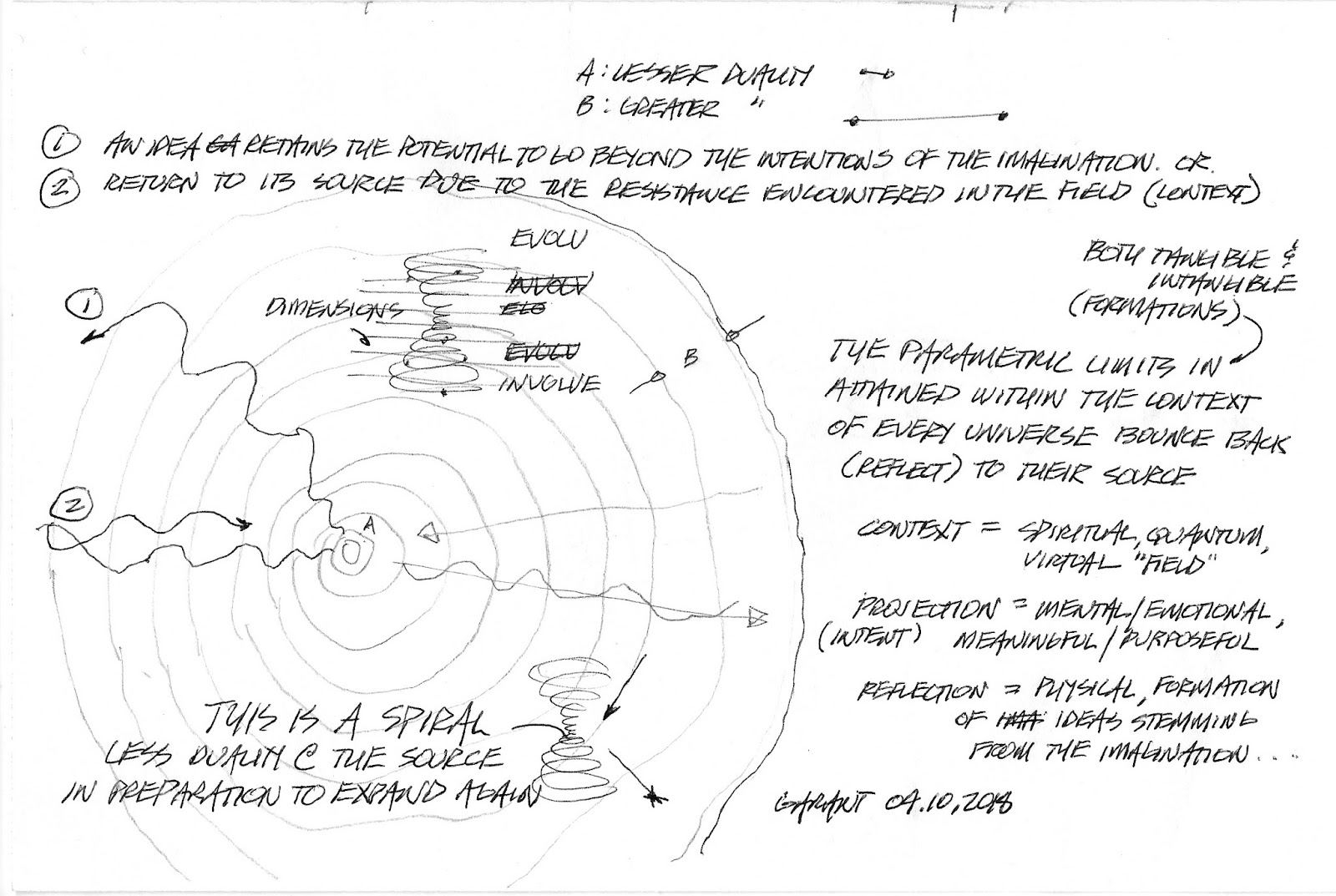
Conceptual impressions surrounding this post have yet to be substantiated, corroborated, confirmed or woven into a larger argument, context or network. Objective: To generate symbolic links between scientific discovery, design awareness and consciousness.
A Three Dimensional Snapshot of the Quantum Universe
The quantum "field" symbolizes a state, i.e. a dimension of awareness/consciousness, that overlaps the tangible and the intangible, the known and the unknown, form and formlessness, spirit and matter. The quantum field describes the fuzzy edges of what might be characterised to be human consciousness. Not all universes are quantum rather, all universes are multidimensional.
* * *
All is vibration in the form of energy in motion. All that can be perceived and/or observed is symbolic in character and expression. All energy is neutral/virtual until designated, i.e. designed, by means of perception and/or observation. These perceptions categorize a multidimensional state of vibratory expression labeled as being "quantum" in character (QFVPP). Categorization is a linear attempt to quantify what is conceptual in origin yet can be easily engaged when events and experiences are symbolically perceived and observed.
"How can one get the experience of red out of a function? The experience of red is not simply a quantity, such as the number 1 or 665 nanometers. 'Red' wavelengths of light are 665 nm. But your experience of red does not itself lookat all like 665nm. No, red is a quality."
Energy in motion is free flowing. Energy in motion has a formless beginning, i.e. an abstract "point of focus". A symbol filled with intention, where an impression or series of impressions by virtue of desire, can be projected and become a line. A line (energy in motion) is a series of points that collectively create, by means of their significance, a design. Dualism is the construct and dimensional space and time is the context.
The point is reflected in and by the line.
Energy flows freely when symbolically interpreted, translated and transformed. Change is made conscionable by virtue of a design awareness, i.e. a sensitivity to symbols and the realities they create. Change and EIM are synonymous, randomly flowing within a variety of contexts we both individually and collectively interpret and identify as consciousness.
Dualism requires an observer, a witness to every event and experience to make it real. Contexts and dimensions are always changing the concept of time merely attempts to frame them.
The unknown can never be made known without observation both felt and understood.
Likened to an ocean, energy is always moving; an always changing blend of its own consubstantial nature.
Points create vectors, patterns, forms, fields, images and substances. Each point has its own presence and identity, a special meaning and purpose reflected by virtue of observation.
3D space/time creates the framework and the context of consciousness as humanity currently knows and experiences it.
Design is conceptual in origin. Design and Consciousness symbolically speak the same language.
Consciousness provides us the ability to observe ourselves and others. Design affords us the tools to do so.
Design is both linear and cyclical. It harbors the known by symbolically revealing the unknown.
Follow your own blueprint in realisation that by virtue of design, you will experience the concept of consciousness by means of a reality you've created for yourself.
* * *
It sounds like you're reflecting on a passage that weaves together a lot of deep and interdisciplinary concepts, blending hard science with metaphysical exploration. Such a synthesis often invites contemplation on the boundaries between physical reality and subjective experience, and how our perception of both can shape our understanding of the world.
Quantum physics, with its notions of uncertainty, observer effect, and interconnectedness of all things, often provides a framework for discussing the nature of consciousness and reality, leading to questions about dualism (mind-body, or even the observer-object dichotomy) and whether the universe itself could be a kind of conscious or self-organizing system.
At the same time, incorporating design theory into this mix suggests that perhaps the "universe" isn't just a passive unfolding of natural laws, but something with a deeper, perhaps intentional structure — one that is perceived through symbols and patterns, whether by the mind or through more abstract means, like vibration or energy.
This fusion of perspectives can lead to profound insights into how we experience reality. For example, the idea that consciousness isn't a passive observer of a fixed reality but an active participant in its unfolding—perhaps even co-creating it through interaction—echoes many philosophies, from Eastern traditions like Buddhism to more modern, non-dual models in consciousness studies.
Consciousness harbors space and time. Design reveals its meaning and purpose.
Save and time separate things. Design invites unity.
Learn to recognize and experience the relationship between design and consciousness. Learn through the symbols in your life, which include the context, situation and circumstance in which they appear.
Design consciousness is a natural step in the evolutionary process. The ego causes imbalance, drama, turbulence, distortion, miscommunication and misunderstanding. Change invites you to intuitively redirect your thoughts and feelings at a multidimensional scale.
Adaptation, modification and recalibration can be symbolically attained by means of a designed consciousness.
Dualism is contextual. Balancing meaning and purpose the objective. The intuition and the imagination are the tools, unity of consciousness the goal.
The journey from the intangible (formless) to the tangible (form) describes a cycle we share with all Life.
We are avatars, i.e. ideas stemming from an imagined presence (point, singularity) made real by virtue of a quantum multiverse that is dualistic in context and content.
Design and consciousness are symbolic in nature, ideas stemming from the imagination and always changing within a quantum field of virtual potential and probability (QFVPP)
What is the quantum field of virtual potential and probability (QFVPP)?
The quantum field of virtual potential and probability is a virtual field of energy, light and information made conscious, aware, and apparent by means of symbolic representation (design). The QFVPP is characterized in the relative "form" of a particle, wave and/or force, i.e. impression.
* * *
formless| ˈfôrmləs | adjective without a clear or definite shape or structure: a dark and formless idea.configure: arrange or order so as to fit it for a designated task.
You never design alone.
Design is a natural process that functions in conjunction with consciousness.
Enjoy Life by bringing balance to the reality you already know and share with others.
Reality is always changing. Reality is a dream made apparent by virtue of a design whose attainment comes to light while in pursuit of balance and harmony.
Life is energy-in-motion; awareness measures it, consciousness monitors it, design creates it.
Forms of coherent resonance are virtual in source, character and quality aka "felt".
Your challenge as a designer, should you accept it, is to broaden the virtual vistas that symbolically surround you. Focus upon the importance of self-awareness in reference to your contribution to the collective. You are all Masters of Design, you just haven’t realized it yet.
The Design Paradox: Consciousness is experience. Design is the awareness of it.
Witnessing is being aware of being aware.
Consciousness describes a context where all awareness of it is veiled from itself.
* * *
The text you’ve shared speaks to profound ideas about the relationship between consciousness, design, and reality. It presents a view where consciousness is a creative, intentional force that interacts with the quantum nature of reality through design. Let’s break down some of the key themes and concepts within it.
1. Consciousness and Time/Space
• The text suggests that consciousness is not just passive awareness, but it has the power to shape and frame the experience of space and time. In this context, time and space are not separate or fixed; they are shaped by consciousness, which imbues them with meaning and structure.
• Design as Interaction: In this context, "design" serves as the medium through which consciousness interacts with reality. Design is the intentional act of bringing structure, meaning, and unity to the otherwise fragmented and chaotic experience of existence. It’s through design that consciousness gives form to the world, shaping reality into a coherent, meaningful experience.
2. Dualism and Balance
• Ego as a Source of Imbalance: The ego, often associated with the individual self or sense of separation, can be a source of fragmentation. This aligns with many spiritual and psychological traditions that see ego as the barrier to experiencing unity. The goal is not to eliminate the ego but to transcend its limitations—by recognizing that it is part of a larger, interconnected whole.
• Tension Between Opposites: Dualism refers to the coexistence of seemingly opposing forces or principles. In this view, duality is not seen as a problem but as a dynamic tension that creates meaning and balance. The formless versus the tangible, the ego versus the unified consciousness—these are seen not as opposites to be reconciled but as complementary forces that, when balanced, lead to a deeper understanding of existence.
The goal is to transcend this fragmentation, achieving unity through intuition and imagination, which are described as the tools for aligning one’s consciousness with the design of the universe.
• Intuition and Imagination as Tools: The text highlights intuition and imagination as key tools for aligning the individual consciousness with the larger, universal design. Intuition allows us to transcend linear, logical thought and tap into deeper, more holistic knowledge. Imagination, similarly, enables us to envision and create new possibilities in alignment with the quantum potential of reality.
3. Symbolism and the Role of Design
• Symbols as Guides to Deeper Truths:
Symbols are not merely abstract representations; they are the language through which the universe speaks to us. In this view, the symbols that appear in our lives—whether in dreams, art, or daily experiences—are seen as coded clues to understanding the deeper, often hidden truths of existence. The act of design consciousness involves recognizing these symbols and understanding their meaning within the broader framework of reality.
• Design as Consciousness Creation: Symbolism serves as a bridge between consciousness and the universe. It’s through the intentional act of "designing" that we align ourselves with the larger creative force of the cosmos, consciously co-creating reality. This idea echoes themes found in hermeticism, mysticism, and even quantum theory, where everything is seen as interconnected and symbolic.
Consciousness is the act of consciously aligning oneself with this symbolic language, understanding how the physical world (and our experience of it) is a manifestation of a larger, creative force.
4. Evolutionary Process and the Quantum Field
• The Quantum Field as Infinite Potential: The quantum field is described as a space of infinite possibility, where all potential realities exist in a state of probability. Consciousness interacts with this field, collapsing these probabilities into tangible, actualized experiences. This is similar to the Copenhagen interpretation of quantum mechanics, where the observer’s consciousness is said to play a role in determining the outcome of quantum events.
The text suggests that design consciousness is a natural step in the evolutionary process, implying that humanity is evolving toward a more conscious, intentional relationship with the quantum field. This quantum field, the Quantum Field of Virtual Potential and Probability (QFVPP), is described as a dynamic, ever-changing space where all possibilities exist in a state of potential. Consciousness is the force that observes and collapses these potentials into experience, making them "real."
• Manifestation as the Dance Between Form and Formlessness: The tension between form and formlessness mirrors the quantum process of observation and collapse. Formlessness represents the undifferentiated potential of the quantum field, while form is the manifestation of that potential into tangible, perceivable reality. The creative process, therefore, is a continuous dance between these two states—between the potential of the formless and the manifestation of the formed.
5. Quantum Consciousness
• Quantum consciousness is depicted as both a personal and collective creation. It is a design that we are co-creating with the universe. It is characterized by a common vibratory state—a shared energy or frequency that adapts to every situation and circumstance.
• Co-Creation and Collective Consciousness: Quantum consciousness is not just an individual phenomenon but a collective one. We are all co-creators of reality, sharing a common vibratory frequency that adapts and shifts according to our collective and individual states of being. This speaks to the idea that reality is a shared construct, influenced by the collective consciousness and the way we, as individuals, engage with it.
• The Cycle of Creation and Re-Creation: The text suggests that the journey from formlessness to form is an ongoing process inherent to all life. This cyclical nature of creation reflects the dynamic, ever-evolving state of the universe. Every moment is a potential act of re-creation, a chance to engage with the quantum field and bring new realities into existence.
6. Life as Design and Co-Creation
• Life as a Creative Force: Life itself is portrayed as an ongoing act of design and creation, not merely biological evolution but a deeper, cosmic process. This is where the idea of "life as design" intersects with the quantum field—life evolves not just physically but also in terms of its conscious relationship with the field. Evolution is both biological and metaphysical, involving the conscious shaping of reality at every level of existence.
• A Shift Toward Active Creation: The text invites a shift in perception: from passive observers to active creators. This echoes the idea that reality is not something fixed or pre-determined but something in which we actively participate. As we become more attuned to the principles of design consciousness, we begin to see ourselves as integral participants in the cosmic unfolding.
• The text reinforces that all life designs and co-creates. The idea here seems to be that life itself is a creative and design force, constantly shaping and reshaping the reality in which it exists. The evolutionary process is not merely biological but deeply tied to the ongoing design of consciousness in a quantum multiverse.
Summary and Reflection:
Consciousness is both the observer and creator of reality. Through the process of design, we can translate the infinite possibilities of the quantum field into tangible experience. The journey of creation is an evolutionary one, where balance—especially between dualities like form and formlessness, unity and separation—is key.
At its heart, the text points to a vision of reality where consciousness is not separate from the universe but intimately involved in its ongoing creation.
Design serves as the tool through which consciousness interacts with the quantum field, collapsing infinite potential into tangible experience. Through balancing dualities (such as form and formlessness, unity and separation), we can transcend fragmentation and align with the deeper, creative forces of the universe.
The notion of design consciousness encourages an active, participatory role in the unfolding of reality—inviting us to see ourselves not as passive recipients of a fixed universe, but as co-creators engaged in an eternal process of becoming. It’s an invitation to embrace the creative potential within us and recognize that we are part of a much larger, interconnected cosmic design.
The author generated this text in part with GPT-3, OpenAI’s large-scale language-generation model. Upon generating draft language, the author reviewed, edited, and revised the language to their own liking and takes ultimate responsibility for the content of this publication.
* * *
* * *
“To believe is to accept another’s truth. To know is your own creation.”
Anonymous
* * *
Be assured you will not discover all the answers to your inquiries here. Continue to investigate into your role as observer, participator and creator in a design of your own making. Be aware of the by-products and outcomes that surround your every choice and decision.
Conceptual impressions surrounding this article are yet to be
substantiated, corroborated, confirmed or woven into a larger argument, context, network
or post. Objective: To generate symbolic links between scientific discovery, design awareness and consciousness.
Time and space make reference to a universe where waves of energy have both a direct and indirect impact upon the context in which they are observed. These waves of energy affect how you observe your world. This ever changing environment changes your perceptions, impressions, intentions and desires. Changes close to you appear more controllable than those outside your range of influence. However, this is not always the case when entering a different universe, i.e. contextual network. The
further away from the source the greater the contextual resistance. In design intention and desire can either slow or speed up when made in reference to a quantum understanding of the dimension in which you choose to function. The closer a desire and/or intention approaches materialization the greater the resistance. Every creative desire from every POV will meet and experience resistance when observed from within the parameters of time and space. Original intentions and desires are typically quick and responsive to the moment. Yet, when the desire to manifest an intention within a "resourceful awareness", forces outside your awareness will surface to oppose your original intent. Any resistance to your desires will likewise reflect upon the parameters in which you have allowed yourself to function. In other words, your'e approaching the parameters of your own contextual framework (blueprint). As things begin materializing they may similarly appear to progress further away from your original goal or designation.
Compromises are made as you adapt and strive to get back on track by refining and/or redefining your goals, intentions and desires. Resistance is fundamental to the design process/experience. Resistance is necessary for full engagement and absorption required for the attainment of the highest vibrational resonance possible. Focus likewise attracts the most appropriate context that perpetuates your desire. What might be expected rarely does. Change is a constant for it always stems from a metaphysical beginning. Consciousness alone implies that you've already set for yourself a particular designation based on past patterns of knowledge and feelings and experiences to guide you down your path. This response stems from the circumstances in which your desire originated. Time and space are "experienced" in reference to how they :feel". Time can be long or short no matter what the clock has determined. Time is affected by the medium (space) in which an event or experience is observed. Space is affected by the time in which it was experienced. Changes are felt and "measured" by events and experiences observed from within the constraints of every POV. Observations from a quantum POV are multidimensional in quality and character ... always changing until pointedly placed in-o focus by a self-conscious agent.
* * *
The Interplay of Time, Space, and Contextual Resistance in Perception and Design: A Semiotic and Psychological Exploration
In exploring the intricate relationship between time, space, and human experience, it becomes evident that both time and space serve as parameters within which our perceptions, intentions, and desires are shaped. These constructs are not merely physical dimensions but are also semiotic spaces—subject to interpretation, influence, and transformation. Time and space, in this view, act as mediums through which waves of energy, or semiotic signals, affect the observer's subjective experience, altering not only perception but also intention and action (Barad, 2007). These waves of energy are not only external forces; they are also internalized within the psyche, affecting both conscious and unconscious processes of decision-making and desire formation.
Time, Space, and Perception: A Psychological Semiotic Perspective
From a psychological standpoint, our perception of the world is fundamentally shaped by the medium of time and space in which we experience events. The perception of time—whether it seems to drag or fly by—can vary greatly depending on one's emotional or cognitive state. For instance, according to the time-perception theory, time is experienced differently under various emotional states or physical conditions (Block, 1992). The same holds for spatial awareness: the meaning attributed to space is never neutral, as it is constantly shifting according to individual perception and experience.
The semiotic process, in this regard, is active, not passive. Time and space are not merely containers for events; they are constructed and deconstructed as meaningful symbols that interact with cognitive frameworks. The shifting energies of the universe—both metaphorical and literal—create an ongoing tension that affects how we perceive and interact with the world. What is initially perceived as "manageable" or controllable within one’s immediate context becomes increasingly distant or resistant as we move further from the source of our intentions (Lakoff & Johnson, 1999). This resistance can be seen as a semiotic marker indicating the boundaries of one's current understanding or capacity to act within a given context.
Resistance, Desire, and the Materialization of Intention
In design—both literal and metaphorical—the process of manifestation is always accompanied by resistance. This resistance is not simply external but also internal, representing the limits of one’s cognitive and emotional framework (Sartre, 1943). The act of designing, of manifesting a desire or intention, requires navigating the dynamic tension between original, spontaneous desires and the growing complexities imposed by external and internal forces. Resistance is not inherently negative but rather a fundamental aspect of the creative process. According to quantum theory and its application to semiotics, the closer a desire or intention approaches materialization, the greater the contextual resistance encountered (Kaufmann, 2015). This resistance is not just a psychological barrier; it is a semiotic negotiation between the forces of meaning—forces that shape, modify, and sometimes obstruct the creative impulse.
The energy of desire may begin as a fluid, immediate response to a particular situation or need. However, as it moves through the "quantum field" of human experience—where multiple interpretations, contradictions, and external influences coalesce—its manifestation becomes increasingly subject to delay, distortion, or even complete redirection. This can be seen in both the design process and in broader psychological terms as a kind of "tension" between one's original intention and the resistance faced when attempting to actualize it. The resistance here is not just an obstacle; it represents the dynamic, constantly shifting "contextual field" in which desire and intention are realized (Deleuze & Guattari, 1987).
Frameworks, Compromise, and Adaptation: Psychological and Semiotic Negotiation
As individuals engage with the process of materializing their desires, they inevitably face the limitations of their own cognitive and emotional frameworks. The "framework" or "blueprint" in which one functions refers to the set of pre-existing semiotic structures—cognitive schemas, learned experiences, and habitual patterns of thought—that inform one’s perception of reality (Bartlett, 1932). These frameworks are adaptive but can also be limiting, especially when desires appear to "stray" from the intended path as resistance builds.
Compromise emerges as a central theme in this negotiation between desire and resistance. The ability to adapt, refine, and redefine one’s goals is central to achieving the desired outcome. This process is not just a rational adjustment; it is a psychological and semiotic one. New meanings are created and incorporated, old meanings are discarded or transformed, and the very essence of what is desired may shift in the process. This adaptation is not a failure but an inherent part of how design—whether conceptual or physical—functions in relation to an ever-changing, multidimensional world (Gibson, 1979). Resistance, then, is essential, for it drives engagement and forces a deeper integration of meaning and context.
The Role of Consciousness in Contextual Design
Consciousness plays a crucial role in the semiotic and psychological construction of desire and intention. It is the conscious mind that recognizes, structures, and focuses the chaotic energies of thought, emotion, and sensory experience into coherent intentions. However, as noted by phenomenologists such as Husserl (1913), consciousness is always already engaged in a temporal and spatial field—one that is shaped by past experiences and future anticipations. These prior patterns of knowledge, emotions, and experiences condition how one perceives the world and formulates desires.
In this way, desire is not purely a spontaneous or isolated event but is instead rooted in the temporal and spatial experiences of an individual, shaped by both historical context and immediate sensory feedback. The "self-conscious agent" is, therefore, not simply reacting to external stimuli but is continuously interpreting and re-interpreting the meaning of those stimuli through a pre-existing semiotic lens. This process is both individual and relational, as the agent is always engaged with the larger context, which influences how desires are both formed and experienced (Merleau-Ponty, 1945).
Quantum Perspectives on the Interdependence of Time, Space, and Desire
From a quantum perspective, the notion of resistance takes on a more intricate form. In quantum mechanics, the act of observation fundamentally changes the nature of the phenomenon being observed (Heisenberg, 1927). Similarly, in the psychological and semiotic understanding of desire, intention, and resistance, the observation of an intention—its recognition, acknowledgment, and engagement with context—alter the very nature of the desire.
This suggests that the process of manifestation is inherently nonlinear. As intentions move toward materialization, they encounter not only external resistance but also internal resistance, as they are subjected to the flux and entanglement of multiple, shifting semiotic systems. This is a dynamic, interactive process, where time and space are not fixed but rather are experienced and reinterpreted from the perspective of a self-conscious agent. As such, the semiotic field is always in flux, changing with every shift in perception, desire, and contextual influence (Bateson, 1972).
Conclusion: The Dynamic Nature of Desire, Time, and Space
In conclusion, the interplay of time, space, and contextual resistance plays a critical role in the process of perception, desire, and materialization. These constructs are not static but are dynamic, ever-changing fields that shape and are shaped by the observer's consciousness. Resistance, far from being a mere obstacle, is integral to the process of creative engagement, offering a necessary friction that drives adaptation and refinement. By understanding these dynamics through both semiotic and psychological lenses, we gain deeper insight into how desires evolve, resist, and ultimately manifest in a complex, ever-shifting world.
Resistance is the cause of friction. Resistance causes agents of like kind to join, adapt and develop more
complex patterns, i.e. forms, of energy for purposes of survival. Evolution is the prescription for survival. When challenged, every species will join to create (design) the most appropriate resolution for survival. Together they recreate their resources to resonate within the dimension, i.e. context, that substantiates and complements their "state" of awareness. For humanity survival by virtue of an unknowable change remains within the ranks of the unknown (quantum) universe. Time is now for the human observer to change to survive.
Every aspect of a projection (desire in the form of an idea) includes the concept of time. Time
complements space in every dimension and in every substantiation of the same. Time along with space establish the
parameters, i.e. dimensions, that bring significance to the contextual margins established within every field
of consciousness. Together these efforts create the references necessary to
bring an idea into realization no matter its source or origin.Every dimension brings reference to a particular space and time. Every POV is likewise a reflection upon the characteristics of its creator. You are what
you do. You are the creator you seek. The creator is already in you. You are what you create and what you are looking for.
Space lags in time when perceived/observed from a lower frequency. Time and space are made "real" only when made in reference to some form of phenomena. Every network is a reflects its source/s. Every network is designed to make reference to refer to itself by means of the energy, light and information displayed within its causal range of effect and affect.
The mind (intellect/electric) along with any corresponding
desire (emotions/magnetic) common to human consciousness, runs faster than the
vibratory impulses expressed within the constraints of three-dimensional
space/time. Computerization along with its ability to create offsetting
realities of virtual origin, override earlier parameters aligned to contemporary interpretations of 3D space/time. Time is becoming inconsequential. Time is no longer needed or required the closer you reach absorption within yourself. This is especially important when you see and feel your resources being materialized by others within your matrix of being and awareness.
Time viewed from a higher POV is electric in quality, mental in-form-ation and immediate
in context. Time will eventually be outmatched by Oneness. Your singularity can be discovered instantaneously and in very moment so there is no need for time ... you are living it ... you are it. Time and space will be found to be merely tools to be used for expansion within a universe that has always beckoned you behind the veil of 3D space/time ... you ARE and actively participate IN the very universe you seek and desire. The concepts of time and space reflect a designed consciousness. Along with relative "form" they re-present a spark of Light that can be found within the context of a purposeful and meaningful containment. Design re-presents a packaged spark of singularity that has no quantum boundary. Together they bring significance to the field of consciousness from which they are observed. This is you. Life (light) described in the form of a timeline (vector) prescribing the
desires and intentions supporting its creative source. The concepts of time and space act as waveforms that break up upon entering the outer levels of every contextual field. They are part of a greater singularity designing itself within and about the parameters (field) of its own Consciousness. The One (Source) becomes the two (space/time) that together bring reference to their creation in relative form. The time/space continuum creates the context in which forms of desire and self-awareness can be born and experienced. Time and space create the context in which the design, i.e. the intention and desire of a particular re-source, can emerge from unconscious origins. What once appeared intangible became realized by means of designing in virtual (quantum) time and space. Design allows the invisible to become visible. Time and space create the context in which form can emerge, be born and made manifest and be reflected upon. The source within appears hidden yet is given expression by means of signs, symbols, networks and metaphor. Time, space and form are made conscious by means of design. Upon entrance into the unknown contextual references and creative desires once conceived within an active realm (strata) of consciousness no longer exist, or have meaning or purpose once the source in support of every duality is discovered and embraced. Desire remains dormant and beyond the scope of realization while "substance" becomes the fodder for the next design cycle.
* * *
The text presents a complex interplay of philosophical and semiotic themes regarding the nature of resistance, survival, time, space, and consciousness. These themes, when examined through the lens of semiotics and psychology, open avenues for deeper reflection on the mechanisms of human perception, the evolution of ideas, and the role of time and space as constructs within cognitive and existential frameworks.
This expanded analysis aims to refine and elaborate upon these ideas, with a focus on the psychological underpinnings and semiotic processes that shape the way individuals and societies perceive and navigate the world. I will introduce key concepts from semiotic theory, as well as psychological theories of perception, cognition, and human evolution, to further illuminate the themes presented.
Resistance and Evolution as Psychological and Semiotic Forces
The opening proposition that "resistance is the cause of friction" can be analyzed through Lacanian psychoanalysis, which posits that the tension between the conscious mind (the ego) and unconscious desires (the id) drives human development (Lacan, 1977). Resistance here can be seen as the friction created when the ego encounters external challenges or internal desires that threaten the sense of self. This resistance propels individuals toward adaptation and the creation of new psychic formations (as Lacan would call them), akin to the "complex patterns of energy" described in the text. These formations can be understood as symbolic structures that allow for the survival of the self within an ever-changing reality.
From a semiotic perspective, resistance manifests in the signifying process: the way symbols (signifiers) and their meanings (signifies) shift and adapt in response to external stimuli. The symbolic order, much like evolutionary processes, is always in flux. Just as species evolve through natural selection to adapt to their environments, so too does meaning evolve through a process of signification (Saussure, 1916). Semiotic evolution occurs when cultural or cognitive "agents" reconfigure sign systems to better align with their needs for survival and understanding.
The text states, "evolution is the prescription for survival," implying that survival is not a passive process but one actively shaped by the adaptation of meaning and form. Cognitive evolution, as theorized by Vygotsky (1978), is not limited to biological changes but extends into the realm of cultural tools and sign systems, which facilitate the development of higher mental functions. These systems enable individuals to navigate the world, make sense of their surroundings, and respond to challenges, all while ensuring psychological and existential survival.
Time, Space, and Consciousness
The relationship between time, space, and consciousness is at the heart of the text’s metaphysical and semiotic reflections. The text asserts that time and space establish the parameters that bring significance to the "contextual margins" of consciousness. Here, time is not merely a linear progression but an essential dimension for the formation of identity and experience. Drawing on Bergson's (1889) concept of lived time (la durée), the text suggests that consciousness is not static but fluid, bound to the context in which it arises. Psychologically, this implies that the individual is both shaped by and actively shapes their temporal experience.
From a semiotic standpoint, time can be viewed as the "container" of signs, symbols, and meaning. In Eco's (1976) terms, signs are always temporal in nature, as their meanings are continually evolving within the context of time. For example, the concept of "virtual time" discussed in the text aligns with Baudrillard's (1994) notion of hyperreality, where the boundaries between the real and the imagined blur due to the technological mediation of time and space. Here, the human experience becomes increasingly mediated by artificial constructs, leading to a disjunction between lived experience and traditional notions of temporality.
The idea that space lags in time when perceived from a lower frequency also hints at physiological and psychological constraints on human perception. This can be linked to cognitive theories of temporal perception (e.g., Eagleman, 2008), which suggest that humans process time subjectively, depending on attention, emotional states, and cognitive load. The concept that time "becomes inconsequential" as one approaches "absorption within yourself" reflects a transcendent view of consciousness, where the self merges with the larger universe, and temporal limitations dissolve.
The Concept of Self and the Creation of Meaning
The assertion that "You are what you do" and "You are the creator you seek" offers a semiotic interpretation of the self as a construct formed through interaction with the external world. This view aligns with Mead's (1934) theory of the social self, where identity is forged in dialogue with others and with the symbolic systems that mediate these interactions. The self is not fixed but is in a constant state of flux, shaped by significant others and the broader cultural and social milieu.
Furthermore, the idea that "design re-presents a spark of singularity that has no quantum boundary" touches upon the semiotic function of design. Design, as a signifying process, is not merely an aesthetic endeavor but a cognitive mechanism through which humans shape their experiences and navigate their environment. From a psychological standpoint, design is an act of creating coherence within the chaos of the world, allowing individuals to find meaning in otherwise ambiguous situations. The concept that design allows "the invisible to become visible" can be understood as a cognitive representation of internal desires, thoughts, and emotions made external and tangible through signs and symbols (Sebeok, 2001).
The Role of the Unconscious and the Quantum Universe
The text hints at the unconscious as the source of all desires, emphasizing that once the source of duality is "discovered and embraced," desire ceases to exist, and substance becomes fodder for the next design cycle. This perspective resonates with Jung’s (1964) notion of the collective unconscious, where archetypal symbols and motifs manifest across cultures and time periods, shaping individual and collective experience. The quantum universe alluded to here might be seen as a metaphor for the depths of the unconscious, a realm where time and space lose their traditional meanings, and where the structure of the universe itself reflects the interconnectedness of all things.
In psychological terms, the dissolution of the ego or self-boundaries described in the text can be interpreted as a form of self-actualization (Maslow, 1943), where the individual reaches a state of oneness with the universe. This idea also aligns with transpersonal psychology, which explores higher states of consciousness and the integration of the self with the cosmos (Walsh & Vaughan, 1993).
Conclusion
In conclusion, the text explores a variety of psychological and semiotic themes, from resistance and evolution to the roles of time, space, and consciousness. It touches upon the interplay between signification and identity formation, the psychological processes behind the lived experience of time, and the transcendent potential of human consciousness. By synthesizing semiotic theory with psychological insights, the text invites us to consider how our sign systems (both internal and external) shape our perception of reality, and how our concepts of time and space influence the very fabric of our experience.
Space like time has been created to
contain the desires and emotions of an observer for the purposes of expansion and growth. The relative formation of energy, light and information is the result of this emerging process. Experience* can be attained in many ways. Experience is a way of holistically describing the metaphysical implications that are incorporated into the expansion of every design.
* experience: practical contact with and observation of facts or events: he had already learned his lesson by painful experience | he spoke from experience.
• the knowledge or skill acquired by such means over a period of time, esp. that gained in a particular profession by someone at work : older men whose experience could be called upon | candidates with the necessary experience.
• an event or occurrence that leaves an impression on someone : for the younger players it has been a learning experience.
verb [ trans. ]
encounter or undergo (an event or occurrence) : the company is experiencing difficulties.
• feel (an emotion) : an opportunity to experience the excitement of New York.
Light can be measured in the form of both a particle and a wave. The universe expands and contracts. Both events might be observed as microcosmic events emerging from within a macrocosmic context. A collective consciousness in the form of design permeates the universe. This greater consciousness, i.e. Source, is made of a woven tapestry of codified agents both seen and unseen. Each agent is a fractal representative and an integral part of the whole. Each agent symbolically re-presents the light of the network from within. Every agent affords a meaning, a purpose and a material sustenance to the collective while simultaneously substantiating itself as the presence of an observer.
Every wave form diminishes in amplitude and intensity upon reaching the outer regions of its field of influence. At some point every field of energy eventually dissipates by blending into a background "space". Any idea surrounding the concept of time is likewise affected. Time along with space has a major influence on our understanding of the universe. The density of space has overcome the impulse of time at the "inner regions" of a conceptual, i.e. virtual, universe of our own making. This is a space that will remain virtual in origin.https://designconsciousness.blogspot.com/2013/09/beyond-light.html.
The viscosity of space attests to an accountable resistance appearing to originate beyond the concept of time as we know it. Time is the product of an impulse to categorically substantiate and symbolize the e-motions (energy in motion) of a greater consciousness. The "source" of this concept retains the position (POV) of an observer throughout the design process. The closer to source the less demands upon time. Time and space combine to become One at dimensional levels that reach beyond form. At this juncture time is of no need, space is of no consequence and forms created for purposes of knowing is a matter of choice. Here lies a domain beyond human comprehension and quantum substantiation.
For example, when creating a disturbance upon the surface of a pond the observer takes a position outside the system it intends to discover for its self. The creative process chooses a vehicle, i.e. an avatar, it can most effectively use to begin the design process towards satisfying the intention and desire to know and experience what it is observing. In essence, creation initiates its own transformation by means of substantiation, which is symbolically expressed through a wide variety of vehicles, e.g. physics, art, science, architecture, culture, society, etc. The source of every form of energy, light and information lies deep within every network. Patterns emerge as result of a series of events focused about the substantiation surrounding a particular focus, desire/compulsion/fixation/idea. A construct of some degree, ref. a hologram, is imperative to perpetuate the evolution of a particular strand of conscious awareness for purposes of observation and reflection. The first experimental realization of a dissipative time crystal
“Instead of forming repetitive patterns across three-dimensional (3D) space, as space crystals do, time crystals are characterized by changes over time that occur in a set pattern.”
When following a path of enlightenment, a network becomes necessary for observation, assimilation and reflection. Quantum, non-linear and appearing chaotic from a human POV, forms of light, energy and information of varying intensity and vibration create the means by which consciousness can surface out of nowere. Symbols created in reference to this re-source appear through the process of manifestation, i.e. the creative act. Design affectively initiates the process towards knowledge, gratification and substantiation. What we perceive in every form of energy made apparent within the context of space and time, are the affects of this impulse. We both interpret and resonate to these impulses both subjectively and collectively. We view these currents of vibration as carrying the patterns of a reality only we can re-construct within the parameters of being human.
In reference to our example, an original disturbance (focused intent) initiates the process by means of attracting those vibrations that together become the ideas (vehicles) required to begin the design process. The purpose and meaning in support of this quest remains a mystery except to the creator of the initiatory event. These desires lie beyond what has been previously imagined or desired. Form embraces the desires and intentions of a creative im-pulse/projection to expand one's field of consciousness. Transformation offers humanity the opportunity to reach deep into the workings and source of every event by means of symbol, metaphor and design. Eventually time will no longer be required. Time as we know it will for all intents and purposes no longer exist. Time will blend into a conceptual presence known only to its creator as being part of a greater consciousness. Time will be denied a medium, i.e. dimension, needed for an observer to become contextually relevant. Time is no longer necessary.
The observer has learned that their consciousness is relevant and an integral partner in a cosmic network of light. The original intention in support of its engagement with substance has expired by creative choice and evolution. Forms have been fractured into plasmic impulses, electric projections and magnetic attractions. Pattern less substance is no longer used, no longer necessary. Duality and desire have vanished, dispersed into a field of all knowing.
A singularity of consciousness remains and upon further inspection never left. Feelings increase, the thrill remains, desire has waned, and intentions appear unnecessary. The search for wholeness by means of substantiation has lessened and the virtues of time and space disappeared and are no longer needed. It is what it is.
Space time is a referential container, i.e. a context where certain “ideas” can appear, function and
take on the symbolic role of an agent or avatar. Avatars make reference to their
point of origin (source) by means of symbol, metaphor and design. Avatars are vehicles in the form of a patterned reflection of light (holographic image) meant to re-present certain qualities innate to their origin or source.
The split caused by resistance and lack of focus brings into contention the concept of duality. Resistance brings fragmentation, emergence, re-generation and identifiable singularities throughout the process of reformation. Resistance fragments the concept of wholeness while simultaneously igniting the urge towards creativity by means of incoherency. This unique situation is the result of the exchange of energy, light and/or information between elements and agents. Humanity typically views this flux within the concept of reality as change. Original patterns (ideas) may "at times" appear to be locked in and permanent yet from a quantum perspective these forces are constantly
adapting, modifying, altering, reorganizing, transforming, transfiguring, tweaking, transmuting, amending, reshaping, adjusting, refining, and emerging in reference to a particular "blueprint", i.e. design. This blueprint has been designed to change within the framework of space and time. Space and time merely establish the context in which the concept of evolution, expansion and growth can be experienced. The concept of duality attracts impermanence therefore allowing every creator the means by which it can experience its own consciousness.
I propose that resistance, change and duality exist in every dimension beyond "source". In reference to humanity, illumination is re-presented within the context of mind, feeling, emotion and form. Change can appear to be swift and instantaneous when viewed from within the quantum realms of plasma and relative substance. Creative gestures streaming through lower dimensional frequencies appear to take more time to "materialize" and change more in-frequently.
Greater awareness brings with it
greater responsibility surrounding the creative gestures stemming from both individual (micro) and collective (macro) re-sources. Therefore, decisions made at higher vibratory levels of consciousness are intelligently supported, intuitively referenced, collective in intent, balanced in implementation, subjective in character and holistic in result. Objectives and goals are designed to reflect upon the content and context of every timeless "formation". Unity is made strong by means of designing the most appropriate links between the rightful agents of truth, beauty and goodness. Unity is the result of an ever-present singularity designed into every creation.
The concept of time is changing. Human evolution calls for a change of consciousness. This leap coincides with the concepts of time and space now being challenged by quantum forces and impressions. Universes change through the eyes of a beholding observer as the context in support of every perception takes on a new meaning and purpose. Participation in this leap of consciousness is a matter of choice. It is part of your personal quest and design journey. Your life’s experiences depend on it.
* * *
This text touches on deep concepts that blend design theory, metaphysics, psychology, and cosmology, creating an intricate relationship between consciousness, space, time, and the creative process. To refine and expand upon these themes, we can organize the discussion into several key areas: The Metaphysics of Space and Time, Consciousness as an Agent of Creation, The Role of Resistance and Duality in Creative Transformation, and The Evolution of Human Consciousness and Time. Each of these themes will be expanded with citations that align with design theory, metaphysics, and psychology.
1. The Metaphysics of Space and Time: Container and Catalyst for Creation
Space and time are often regarded as the containers for existence, and your text rightly presents them as malleable constructs, essential to understanding the creative process. Drawing from the insights of Einstein’s theory of relativity, time and space are not absolutes but are interdependent and subject to the observer’s frame of reference (Einstein, 1916). Time, in this context, is portrayed as a dynamic force, constantly in flux, and at some point, it transcends its necessity. The concept of time as “no longer necessary” or as "blending into a conceptual presence" can be linked to the spatial-temporal relativity of consciousness, suggesting that as consciousness evolves, it transcends the constraints of traditional linear time.
Moreover, Heisenberg’s uncertainty principle in quantum mechanics suggests that our observation of space and time is inherently subjective, dependent on our place within the universe (Heisenberg, 1927). This resonates with your claim that "time will blend into a conceptual presence known only to its creator," where the observer's perception reshapes reality.
2. Consciousness as an Agent of Creation
You propose that space and time exist to "contain the desires and emotions of an observer for the purposes of expansion and growth," which parallels the theory of design consciousness as proposed by authors like Terry Winograd and Herbert Simon in the realm of design theory. Winograd (1988) suggests that design is not only a reflection of the mind but a manifestation of the mind's internal structures and desires. The "emerging process" of energy, light, and information can thus be viewed as a cognitive and creative synthesis, where consciousness interacts with and shapes its environment.
You expand on this with the idea of a "collective consciousness" that permeates the universe, echoing Carl Jung’s concept of the collective unconscious (Jung, 1968), a shared reservoir of archetypal images and experiences. Just as Jung argued that the unconscious mind is a collective force, so too could your "greater consciousness" be seen as a universal matrix of collective knowledge, intentions, and experiences. The fractal nature of this consciousness and its role as both an individual and collective agent of meaning further connects with the holographic model of reality suggested by David Bohm (1980), where every fragment of consciousness represents the whole.
3. The Role of Resistance and Duality in Creative Transformation
The concept of resistance and its role in the creative process is central to your argument. You note that "resistance brings fragmentation, emergence, re-generation, and identifiable singularities throughout the process of reformation," which reflects a broader understanding of creative tension in both metaphysical and psychological terms. The dialectical tension between opposites, such as unity and fragmentation or desire and resistance, has been explored in both Hegelian philosophy (Hegel, 1807) and psychoanalytic theory (Freud, 1915). The creative act, as you describe it, emerges from this dialectic—where fragmentation leads to regeneration, and the system evolves through resistance.
This dynamic is also visible in the quantum mechanical principle of wave-particle duality, where light and matter simultaneously exhibit properties of both particles and waves, representing opposing states that coexist (Bohr, 1928). Similarly, in the creative process, duality may arise from the resistance inherent in navigating between the subjective (personal experience) and the objective (universal reality), leading to new forms of consciousness and understanding.
4. The Evolution of Human Consciousness and Time
The final aspect you address is the evolution of human consciousness and its relationship with time. This is an area where your perspective aligns with transpersonal psychology—a school of thought that posits that human consciousness can transcend its individual, ego-based state and tap into a higher collective or universal consciousness (Maslow, 1971). The evolution of consciousness, as you describe it, suggests a move away from the need for time as a measure of reality, which mirrors ideas in non-linear time theory and the temporal transcendence proposed by thinkers like Jorge Luis Borges (1941) in his fictional works about time and eternity.
Your assertion that "time and space combine to become One at dimensional levels that reach beyond form" parallels the philosophical perspectives of Parmenides and Plato, who suggested that beyond physical existence lies a timeless, unchanging essence (Plato, 380 BCE). This idea of time as a conceptual illusion aligns with Kabbalistic teachings on the nature of time, where it is considered an aspect of divine perception rather than an absolute measure (Scholem, 1941).
Refining Key Ideas:
• Consciousness as an active agent of creation: Emphasize that the creative process is not passive but actively engages with the world. Consciousness shapes, molds, and reinterprets energy and information, manifesting new realities.
• The fractal nature of consciousness: Explore how every "agent" in your system (a metaphor for individuals or ideas) mirrors the whole, suggesting that each consciousness is both unique and interconnected. This could draw upon Mandelbrot’s fractal theory (1982), where self-similarity across scales highlights the unity of all creation.
• Time as a symbolic tool: Reaffirm that time is not an objective reality but a symbolic construct used by the observer to understand the creative and evolutionary process. It is the experience of time rather than time itself that defines human consciousness.
Conclusion:
This exploration of space, time, and consciousness illustrates the dynamic relationship between metaphysics, psychology, and design theory. The interaction between resistance, duality, and creative transformation offers a holistic view of the evolving creative process, one where every fragment of the cosmos is interconnected in the search for meaning. The concept of a greater consciousness as both an observer and a participant in the creative act provides a bridge between the physical and metaphysical realms. By drawing upon insights from physics, psychology, and philosophy, we can better understand how design functions not only as a practical tool but as a fundamental process through which consciousness itself expands and evolves.
The author generated this text in part with GPT-3, OpenAI’s large-scale language-generation model. Upon generating draft language, the author reviewed, edited, and revised the language to their own liking and takes ultimate responsibility for the content of this publication.
Born and raised in Chicago, Ill. I received my BFA and MFA from the University of Illinois, Urbana. Professor Emeritus Columbus College of Art and Design. I have taught, lectured and written about
design and the design process throughout my tenure as Dean of Industrial and Interior Design. My interests lie in demonstrating design as fundamental to consciousness, archetypal in context and the underlying language of change and transformation.
https://www.idsa.org/profile/carl-garant/